
Theme 2 – (Promote Industrial Development)
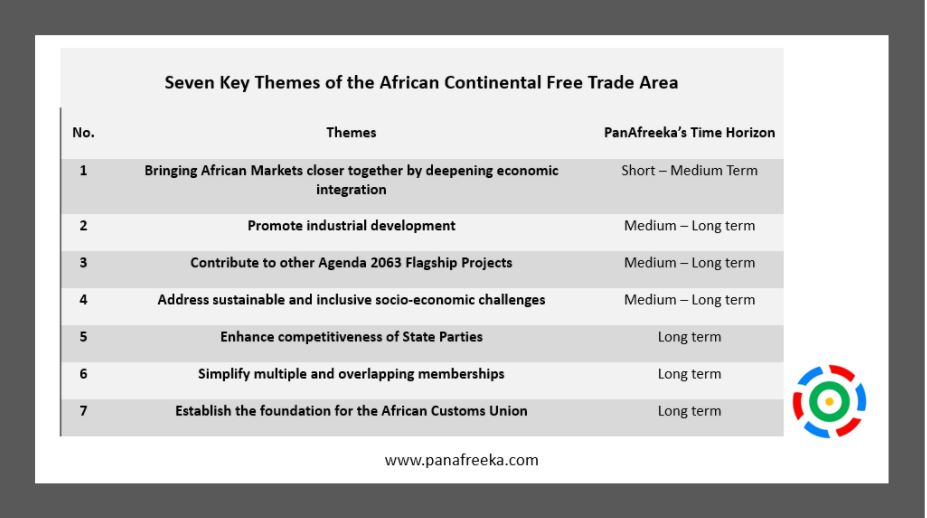
The second theme focuses on the promoting of industrial development through diversification and regional value chain development, agricultural development and food security (Ref-1).
The African Continental Free Trade Area Agreement is an intentional effort to open up a market of about 1.2 billion people with a gross domestic product of USD 2.5 trillion across all 55 member states (Ref-4). Consolidating into one trade area provides great opportunities for industrial development.
The Potential for Industrial Development
For the private sector, the prospect of having better access to a market of 1.2 billion people (Ref-4) can trigger a whole range of capital investment to scale up production and manufacturing to meet the potential demand.
For the public sector, this can trigger a whole range of capital investment into public infrastructure that will stimulate all areas of the local (in-country) and regional value chain.
For the skills, training and education sector, this can result in the need to scale up either in the form of new courses and/or qualifications or in the form of increasing the capacity of students that the institution can accommodate as students so as to supply the skillsets needed by the public and private sector.
There is also a significant opportunity for industrial development with respect to food security and agriculture development. Today, Africa remains a net importer of food although it has 60% of the world’s uncultivated arable land (Ref-2). In other words, not only does Africa have the potential to feed itself, it also has natural capabilities to feed other continents. There is therefore opportunity for industrial development in the demand that becomes apparent from the need to feed at least 1.2 billion Africans.
Initiatives that promote, encourage and execute on industrial development in agriculture and other sectors will therefore go a long way in enabling African trade stakeholders to take maximum advantage of the intra-African trade opportunities that the Agreement offers. These should however be done without leaving behind the startup, small and medium size players (i.e. businesses and traders) in the market so as not to perpetuate the structural socio economic inequality that plagues our world today. The negative economic impact on the measures taken to curtail Covid 19 pandemic has been huge to the business community as a whole however, these specific small and medium sized players are less likely to have the relationship and human capital to navigate the intricacies of scaling up a business or navigating the intricacies of cross border trade so we are of the view that State Party Government has a responsibility to step in, organise, educate, consult with and facilitate the process of including these groups of players in the industrialisation journey.
References (Ref.)Agreement Establishing the African Continental Free Trade Area – African Union https://www.weforum.org/agenda/2016/01/how-africa-can-feed-the-world/https://au.int/en/agenda2063/aspirations African Continental Free Trade Area Question and Answers – United Nations Economic Commission for Africa (Africa Union) https://www.sacu.int/show.php?id=394 |
|
Useful Links (UL) https://au.int/en/agenda2063/overview The Continental Free Trade Area (CFTA) in Africa (A Human Rights Perspective) – United Nations Economic Commission for Africa |