

Scope of the African Continental Free Trade Area – [Part B (4 of 4)] – The AfCFTA Protocol on Trade in Services and associated Annexes
PanAfreekan Reflections on the Protocol on Trade in Services
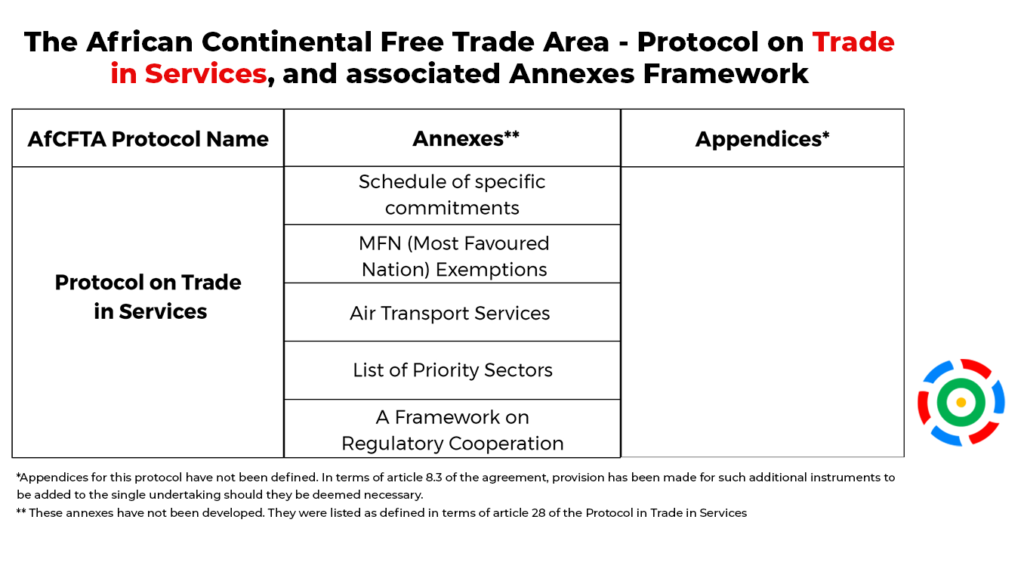
Unlike the Protocol on Trade in Goods, the level of detail at the time of writing this for the Protocol on Trade in Services is a little low. We are hopeful that the detail around the Annexes will eventually be published and we will have the opportunity to revisit this protocol. For now, however, we will reflect on some thoughts that jump out to us as we deliberate on the protocol on Trade in Services in the context of the entire Agreement.
The Protocol on Trade in Goods needs the Protocol on Trade in Services
Our first thought has to do with the link between the two Protocols i.e. trade in goods and trade in services. We will argue that for a full goods manufacturing and sales cycle (i.e. extraction of raw materials used to make goods to the point where the customer purchases and owns the goods) to be achieved, the Protocol on Trade in Services enables the Protocol on Trade in Goods.
There is very little motivation to manufacture goods if the process of buying and consuming the goods is compromised considering that sales are primarily how the manufacturer generates revenue. So many things around the manufacturing of the goods are service driven. Furthermore, the process of purchasing the goods as well as having the goods transported from the manufacturer directly or indirectly (e.g. via a wholesaler and/or a retailer) is (logistically) service driven. Also when goods are damaged or when they malfunction, the process of repairing and maintaining the goods is service driven and even when the goods have reached the end of their life span, we can argue (especially in the context of environmental friendliness and possible the recycling of components) that the process of disposal of the goods is service driven.
Without services, the Protocol on Trade in Goods will struggle to flourish and the custodians of the (Continental Free Trade Area) Agreement owe it to all goods manufacturers to ensure that their ability to boost intra-African Trade in goods is not held back by service-oriented support that is not of sufficient calibre to handle the protocol on trade in goods requirements.
The Protocol on Trade in Services needs infrastructure Development
Fostering an enabling environment for Intra African trade requires not only the development of infrastructure but also ensuring that there is a reasonable balance between ensuring that the infrastructure is accessible to most of the population (if not all) and revenue generation from that infrastructure.
To illustrate what we mean by infrastructure further we need to look no further than the Covid 19 pandemic. The new normal of the Covid 19 pandemic has seen a significant proportion of non-customer facing service workers alter their life and work from remote locations such as their homes. The ability to still be a productive employee from a remote location may come at a cost and this cost can be influenced by infrastructure development so much so that in some countries Internet connectivity might be widely available and affordable and in others, it may be reserved for the rich as only they can afford the cost of spending extended amounts of time on the Internet.
When we think of trading in services whereby multiple stakeholders are working together across the continent in separate locations, it’s easy to see how a lack of infrastructure (e.g. reliable Internet connectivity) can become an obstacle to collaboration. Furthermore, it can also lead to unintentional discrimination whereby certain countries with better infrastructure are favoured over others simply because of the ease of trading (boosted by a more advanced infrastructure development).
Our point here boils down to the reality that an abundance of infrastructure development or lack thereof can be an opportunity or a threat to every State Parties Continental Free Trade Strategic objectives. We believe that it is the responsibility of Domestic Governments to factor the African Continental Free Trade Area Agreement considerations into their infrastructure development plans where possible make a concerted effort to find quick wins that can be developed in a reasonably short time that will translate into boosting intra-African inbound and outbound trade not only for that State Party but for the benefit of the people of that State Party.
The implication of the Protocol on Trade in Services for each State Party will vary following the development of the Annexes
We look forward to the detail on the Annexes as we are of the view that depending on what is agreed on and adopted by the Assembly, the implications at State Party levels may result in interesting developments which may place certain State parties and their stakeholders (e.g. domestic industries and national governments) at an advantage over others.
As an example, the sectors agreed to in the list of priority sectors Annex automatically means that State Parties that have a more advanced domestic industry in those sectors will have an advantage in servicing the rest of the continent over other State Parties whose domestic industries in those sectors are not as progressive. This may also lead to all kinds of consequences such as a reduction in the support and buy-in of the AfCFTA within a State Party where these priority sectors are least advanced as they may view potential incoming competitors as unfair competition.
The same goes for a framework for regulatory cooperation. The more or less aligned or complementary a State Party’s regulatory framework (especially related to trade and related regulation such as e.g. trade and labour laws) is to the regulatory framework agreed to, the easier or more difficult it may be to meeting the requirements of the Protocol on Trade in Services.
The process of passing new legislation or amending existing legislation can be quite extensive as it requires multiple processes such as public comments, debates in the parliament and buy-in in the form of a parliamentary vote before it can even make it ready to be adopted into law. This is yet another point where politics can get in the way. It’s not uncommon for opposition parties to take sides with the public who are opposed to such changes and exercise their parliamentary voting rights against such changes. This means that some State Parties may have it easier when it comes to internal changes that need to be made to align to the regulatory framework annex than others.
Unlike the Protocol on Trade in Goods, the Protocol on Trade in Services is not as detailed and while we are about to end this series we intend to revisit as soon as more information becomes available. The one evident thing is that we cannot trade in goods without the service-oriented support that is needed in the end to end cycle of a trade.
Final Words
We have come to the end of this series. We may revisit it in future. If you have found this informative, we would like to recommend another series of ours – General objectives of the African Continental Free Trade Area where we introduce PanAfreeka’s seven key themes of the African Continental Free Trade Area objectives, and through this framework provide an overview of the general objectives of the African Continental Free Trade Area.