

As part of Agenda 2063’s blueprint and plan to transform the Africa that is into a global powerhouse of the future (AU’s words, not ours) [UL-1] or as we prefer to word it, the Africa we want, or the Africa that’s possible, the African Continental Free Trade Agreement has set out a range of key objectives that it aims to address in ensuring the overarching mission of boosting intra-African trade.
General Objects of the African Continental Free Trade Area
In terms of Article 3 of the Agreement, the general objectives of the African Continental Free Trade Area (AfCFTA) Agreement are:
(a) create a single market for goods, services, facilitated by movement of persons in order to deepen the economic integration of the African continent and in accordance with the Pan African Vision of “An integrated, prosperous and peaceful Africa” enshrined in Agenda 2063;
(b) create a liberalised market for goods and services through successive rounds of negotiations;
(c) contribute to the movement of capital and natural persons and facilitate investments building on the initiatives and developments in the State Parties and RECs;
(d) lay the foundation for the establishment of a Continental Customs Union at a later stage;
(e) promote and attain sustainable and inclusive socio-economic development, gender equality and structural transformation of the State Parties;
(f) enhance the competitiveness of the economies of State Parties within the continent and the global market;
(g) promote industrial development through diversification and regional value chain development, agricultural development and food security; and
(h) resolve the challenges of multiple and overlapping memberships and expedite the regional and continental integration processes. (Ref-1)
PanAfreeka’s Seven Main Themes of the African Continental Free Trade Area Agreement
In these series of articles, we intend to provide more context around the objectives stipulated in Article 3 (also listed above) of the Agreement Establishing the African Continental Free Trade Area (Ref-1), we have grouped these objectives into a framework entitled PanAfreeka’s Seven main themes of the African Continental Free Trade Area Agreement in the table below. Kindly note that the time horizon listed below were not sanctioned by the Agreement but rather by us based on our understanding of these objectives, how they relate to each other as well as the state of affairs on the continent. Furthermore, beneath the table, we explain how we arrive at the themes by linking them back to the general objectives in Article 3 of the (Continental Free Trade) Agreement.
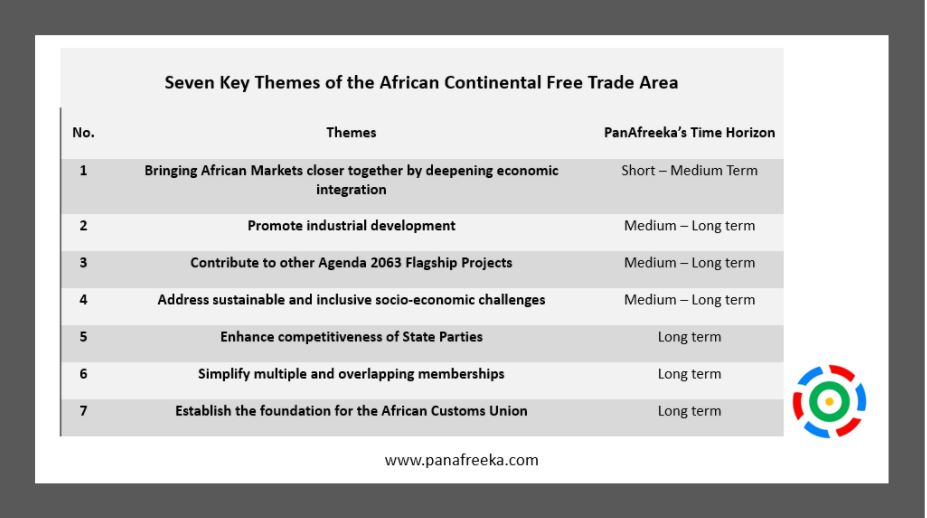
Theme 1 – Bringing African Markets closer together by deepening economic integration
In order to trade, there has to be buying and selling, meaning there has to be a market. In theme one, we will provide some context on this as it relates to Article 3(a) and 3(b) of the AfCFTA Agreement.
Article 3(a)
Create a single market for goods, services, facilitated by movement of persons in order to deepen the economic integration of the African continent and in accordance with the Pan African Vision of “An integrated, prosperous and peaceful Africa” enshrined in Agenda 2063;
Article 3(b)
Create a liberalised market for goods and services through successive rounds of negotiations.
Theme 2 – Promote Industrial Development
The effort to diversify African production beyond commodities type industries and significantly expand into industrialised development has been highlighted as one of the objectives of the AfCFTA. In this theme we will provide an overview as it relates to the objectives stipulated in Article 3(g) of the Agreement i.e.
Article 3(g)
Promote industrial development through diversification and regional value chain development, agricultural development and food security.
Theme 3 – Contribute to other Agenda 2063 Flagship Projects
In Theme 3, we will unpack the relationship between the general objectives of the AfCFTA and the other Agenda 2063 flagship projects most especially to do with Article 3(c) of the Agreement.
Article 3(c)
Contribute to the movement of capital and natural persons and facilitate investments building on the initiatives and developments in the State Parties and Regional Economic Communities (RECs).
Theme 4 – Address sustainable and inclusive socio-economic challenges
There are also objectives to address gender inequality and Africa’s high youth unemployment as stipulated in Article 3(e)
Article 3(e)
Promote and attain sustainable and inclusive socio-economic development, gender equality and structural transformation of the State Parties.
Theme 5 – Enhance competitiveness of State Parties
This theme addresses the objective of a more competitive Africa. For this to take place both growth and structural transformation of economies are required and we will provide some thoughts on this as it relates to Article 3(f).
Article 3(f)
Enhance the competitiveness of the economies of State Parties within the continent and the global market.
Theme 6 – Simplify multiple and overlapping memberships
This theme addresses the objective of Article 3(h) of the Agreement. It has to do with tackling the complexities around the continental and international trade obligations of African countries. The idea here is that if the AfCFTA delivers then it should be possible to get the buy in of African countries and simplify the existing fractured economic institutions and maybe someday dissolve into a holistic one that can achieve more productive collaboration and negotiating power.
Article 3(h)
Resolve the challenges of multiple and overlapping memberships and expedite the regional and continental integration processes.
Theme 7 – Establish the foundation for the African Customs Union
The AfCFTA is an ideal test case for a future African custom union. As stated in Article 3(d), in this theme we will unpack the long term objective of first establishing of an internal Continental Free Trade zone and over time through a series of iterative amendments transition African continent into a continental customs union trade bloc.
Article 3(d)
Lay the foundation for the establishment of a Continental Customs Union at a later stage.
The objective of this article was to provide a very brief perspective of the general objectives of the (Continental Free Trade Area) Agreement. In our future articles we will revisit the PanAfreekan Themes introduced above and provide more detail as well as some reflections.
References (Ref.)Agreement Establishing the African Continental Free Trade Area – African Union https://www.weforum.org/agenda/2016/01/how-africa-can-feed-the-world/https://au.int/en/agenda2063/aspirations African Continental Free Trade Area Question and Answers – United Nations Economic Commission for Africa (Africa Union) https://www.sacu.int/show.php?id=394 Useful Links (UL)https://au.int/en/agenda2063/overview The Continental Free Trade Area (CFTA) in Africa (A Human Rights Perspective) – United Nations Economic Commission for Africa |
A brief nice introductory article into the AfCFTA concept. The article lays the foundation from which the reader will be taken through a journey as he/she reads the 7 themed as identified by PanAfreeka around the general objectives of the African Continental Free Trade Area. Looking forward to reading the insights of the team on these grouped themes.