
Scope of the African Continental Free Trade Area – [Part A (9 of 9)] – PanAfreekan Reflections on the Protocol on Trade in Goods Objectives (Part 2 of 2)
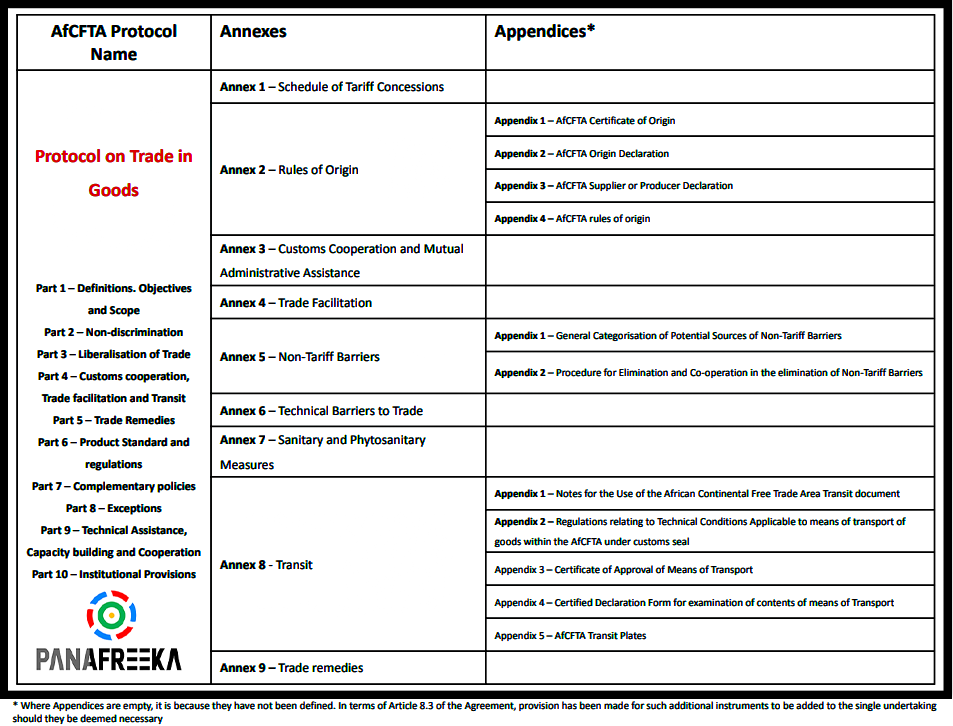
This is the second part of PanAfreekan Reflections on the Objectives of the Protocol of Trade in Goods listed below. We shared our thoughts on the first four objectives in the first part, and in this section, we will be sharing some reflections on numbers 5 and 6 below.
Article 2 of the Protocol on Trades in Goods lists its objectives as follows:
- Progressive elimination of tariffs
- Progressive elimination of non-tariff barriers
- Enhanced efficiency of customs procedures, trade facilitation and transit
- Enhanced cooperation in the areas of technical barriers to trade and sanitary and phytosanitary measures
- Development and promotion of regional and continental value chains
- Enhanced socio-economic development, diversification and industrialisation across Africa
Development and promotion of regional and continental value chains
The development of value chains is an interesting objective because, in order to boost intra-African trade under the (Continental Free Trade Area) Agreement, there will have to be an intentional effort to boost intra-African value chains. This is because, in the process of manufacturing, a product will have had to be wholly obtained from another State Party (see Article 5 of Annex 2) or sufficiently Worked or processed (See Article 6 of Annex 2) in order to qualify for the concessions of the Agreement. This means that the Agreement offers an incentive to local business to manufacture products locally using locally sourced materials, resources and possibly even labour.
Developing regional and continental value chains also offer an opportunity for industries within State Parties to find a niche in a value chain and invite continental businesses to outsource that part of their value chain to them. What this means is that the (Continental Free Trade Area) Agreement allows African industries and State Parties to collaborate and leverage off each other’s best capabilities to create good quality products to a market of 1.2 billion whilst taking full advantage of the benefits of the (Continental Free Trade Area) Agreement.
This same principle can be applied to the Protocol in Trade in Services whereby African businesses are able to source services from across the continent to fulfil parts of their value chain that are service-oriented.
In concluding this section, we would like to deliberate on the socio-economic impact of the development and promotion of value chains. One of the major concerns about the Free Trade Zone is that if left unchecked its benefits may only be explored and exploited by large businesses. To prevent this, we believe that there should be a concerted effort by domestic governments to (through structured Government driven initiatives) incorporate the capabilities of informal micro, small, and medium businesses and traders who by themselves may not be able to export to other markets but through organised programs by the domestic government may be able to “plug-in” and participate in the value chain of larger corporations.
Enhanced socio-economic development, diversification and industrialisation across Africa
This last objective of the protocol on trade in goods aligns with one of the key aspirations and its corresponding goals of Agenda 2063. By this, we are referring to Aspiration 1 – “A prosperous Africa based on inclusive growth and sustainable development” alongside its goal of “Transformed economies”.
It’s easy to see how trading in goods in a Free Trade Zone can stimulate industrialisation and diversification as well as address socio-economic issues on our continent but the challenge has to do with deciding this is going to take place, and making an intentional effort to implement programs to encourage this.
Socio-economic development
In the development and promotion of value chains, we touched on the need for an intentional approach to ensure that informal, micro, small and medium businesses are not left behind on the Free Trade Zone possibilities that come with value chains. We would like to build on this for this objective because socio-economic issues are deeper than just outsourcing a small part of your business to a smaller organisation. For instance, socio-economic may require the need to formalise informal businesses so that they can participate in these outsourcing opportunities and to do this well, it may require the need to lower barriers to (formalisation) entry (e.g. business tax exemption for certain kinds of businesses) to make registration of informal businesses attractive.
Just like participating in value chains, the other two sub-objectives i.e. diversification and industrialisation will require certain skillset and socio-economic development programs can help supply these skillsets, however, in order to ensure that there is buy-in, the barriers to taking advantage of any such programs will also need to be tackled. Examples of this may be subsidised, sponsored or free education.
Finally, it’s also a lot easier to participate in the Free Trade Zone when the quality of life of the population especially the poor is higher. For example, the degree of access to decent food, healthcare and accommodation for as many people in the population as possible may directly correlate with the interest in socio-economic development programs that government may have in place to participate in the Free Trade Zone.
Socio-economic development efforts can not only increase participation in the Free Trade opportunities benefits but can potentially help the poor do something about poverty in a dignified manner. However, beyond this, every person lifted out of poverty on the production side of a trade in Africa becomes an additional consumer for the goods that are being sold as per this protocol and a large consumer base offers an opportunity for governments to recoup any investment made in such programs through mechanisms such as sales tax that comes with having such sales transactions in their territory.
The enhancement of the socio-economic development objective is not unique to the Protocol on Trade in Goods but is also echoed as an Objective of the (Continental Free Trade Area Agreement. For more info on this, please see Theme 4 of our General Objectives of the African Continental Free Trade Area.
Diversification and Industrialisation
The African Continental Free Trade Area and protocol on trade in goods offer an opportunity for Africa to diversify beyond its over-reliance on Commodities.
The Covid 19 “stay at home” or “lockdown” orders resulted in a huge boom in online shopping. A significant portion of this shopping was sourced from outside the continent. We believe that this pandemic is a potential business case to analyse and determine opportunities for diversification in State Parties, regional economic communities and the continent as a whole.
To illustrate this better, the AU can instruct State Parties to analyse the import data of e.g. the top 100 products that were imported by Africans across the continent in the year 2020. This report provides a template of products that are likely to be in demand on the continent. An analysis can then be commissioned to see the manufacturing capabilities on the continent to meet such demand and in instances where there is a shortfall between capability and demand therein lies an opportunity for diversification.
Once opportunities for diversification are evident, then industrialisation may follow not far after. There may be a few steps in between e.g. deciding on which areas to industrialise in given the abundance/scarcity of resources required to manufacture on a wide scale for potential opportunities. Our point here is that in the Free Trade Zone, every State Party has the opportunity to find a niche or two where it’s possible to diversify and industrialise so as to meet consumers demand in an industry that has a high demand across the continent.
The above example is just one illustration of tangible ways in which the opportunities to diversify and industrialise can be explored. Coupled with this is the development of value chains objective and protocol on trade in services to supply service-oriented parts of value chains and the African Continental Free Trade Area Agreement offers endless opportunities for Africans to step in and produce the goods that Africans import from outside the Free Trade Zone.
Final Words
We have come to the end of this series. If you have found this informative, we would like to recommend another series of ours – Agenda 2063 Flagship Projects. It contains a series of articles that provides an overview of the African Union Agenda 2063 projects of which the African Continental Free Trade Area Agreement is just one.
We thank you for reading.
References (Ref.)
- Agreement Establishing the African Continental Free Trade Area – African Union
- Protocol on Trade in Goods
- http://www.itac.org.za/pages/services/trade-remedies
Useful Links (UL)
- Agreement Establishing the African Continental Free Trade Area – African Union
- Protocol on Trade in Goods
- https://www.bdc.ca/en/articles-tools/entrepreneur-toolkit/templates-business-guides/glossary/technical-barriers-to-trade
- http://tfig.unece.org/contents/gatt-v.html#:~:text=WTO%20GATT%20Article%20Vdefines%20international,warehousing%2C%20breaking%20bulk%2C%20or%20change
One thought on “Scope of the African Continental Free Trade Area – [Part A (9 of 9)]”