
Scope of the African Continental Free Trade Area – [Part A (8 of 9)] – PanAfreekan Reflections on the Protocol on Trade in Goods Objectives (Part 1 of 2)
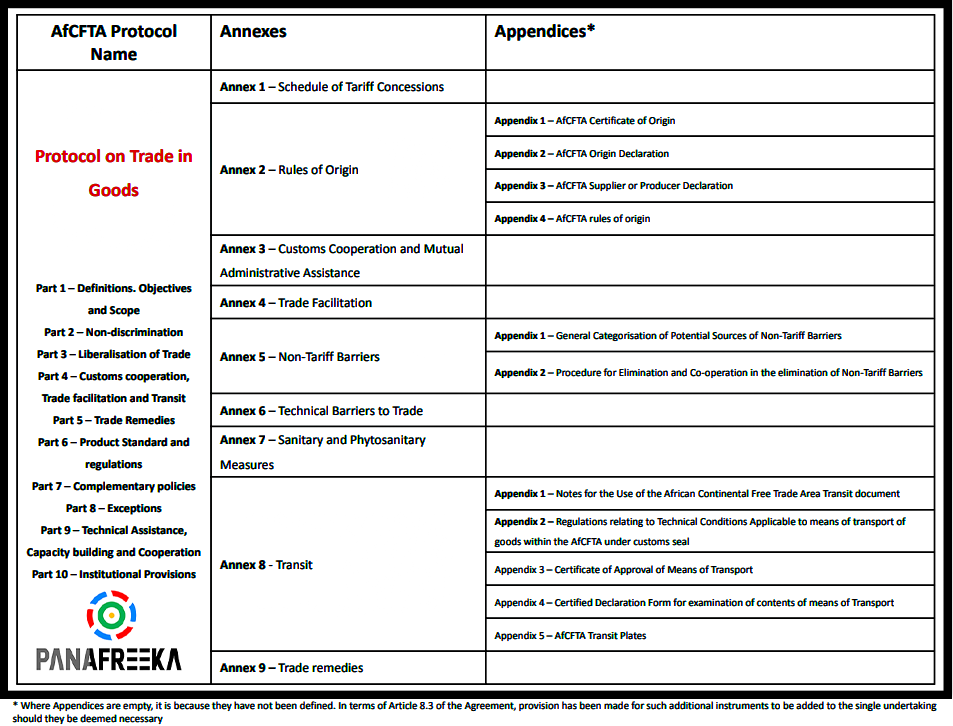
PanAfreekan Reflections on the Protocol on Trade in Goods Objectives
In this publication (and the next) we would like to share some of our reflections on the Protocol on Trade in Goods and to do this we will be focusing on the objectives defined in Article 2 of the Protocol on Trades in Goods objectives listed as follows:
- Progressive elimination of tariffs
- Progressive elimination of non-tariff barriers
- Enhanced efficiency of customs procedures, trade facilitation and transit
- Enhanced cooperation in the areas of technical barriers to trade and sanitary and phytosanitary measures
- Development and promotion of regional and continental value chains
- Enhanced socio-conomic development, diversification and industrialisation across Africa
The Protocol of Trade in Goods objectives is very much aligned and perhaps a subset of the Specific Objectives of the African Continental Free Trade Area (See Article 4 of the African Continental Free Trade Area Agreement). In the past few articles, we had discussed the Annexes (and in relevant cases) Appendices of the Protocol on Trade in Goods, however, we wanted to wrap up this series by recapping the above objectives of the Protocol in itself and provide some PanAfreekan reflections.
Progressive elimination of Tariff and Non-Tariff Barriers
One key point worth noting is that some of these objectives are progressive by description, in other words, the tariffs and non-tariff barriers are not going to suddenly vanish as this could be detrimental to domestic (i.e. business operations that operate within state parties) industries and businesses. What is more realistic is the gradual reduction over time until tariffs are eliminated. However, in all likelihood, we may never reach an eventuality where 100% of goods have zero tariffs because State Parties are entitled to a series of safeguard measures as well as special and differential treatments clauses that can be invoked in instances when the cost of abiding by the agreement outweighs its benefit.
An example of this will be clauses that allow a State party to impose measures for protecting an infant industry that has strategic importance at the national level.
Customs Procedures, trade facilitation and transit
Underpinning any successful free trade agreement is free movement (of people and goods) and the enhanced efficiency of customs procedures, trade facilitation and transit objective will go a long way to ensure efficiency when it comes to the time it takes for goods to move between state parties or from Seller in one country to Buyer in another.
In order for this objective to be realised though, there will have to be a lot of collaboration at the customs level and this collaboration will not only require the working together of human resources and administration but may also require the working together of systems, procedures and processes. This objective alongside the non-tariff barriers is key in that it can literally be a deciding factor for a business or customers on whether or not to take advantage of the Free Trade Area.
The inefficiency of customs procedures and goods transit may not only result in frustration for businesses who want to move goods across borders but may also result in consumers who opt to purchase from outside the Continental Free Trade Zone while paying more for their goods just so they can get it sooner.
Technical Barriers to Trade and Sanitary and Phytosanitary measures
As a manufacturer who wants to export to other State Parties, knowing whether the current goods being produced meets the standards in another State Party or being able to determine what adjustments need to be made to the current goods being produced so they can meet standards of another State Party is key in business operations. However this can be cumbersome in a Free Trade Zone should each State Party have different Standards and this, is the reason for the need for enhanced cooperation in the areas of technical barriers to trade and sanitary and phytosanitary measures. This specific objective will require lots of cooperation and may probably be the most difficult objective of all considering some of these standards are informed by pieces of legislation, regulations and domestic industry standards in the various State Parties.
Furthermore, they will require some State Parties to “drop” their Standards and other State Parties to “raise” theirs and the ripple effect may have far and wide consequences some of which are obvious like downstream job losses (or gains) and others not so obvious like politics. The constituency of the AU assembly are representatives of governments several of which are politicians and in politics, politicians may be very reluctant to make and implement decisions that could negatively impact their political legacy or harm their political ambitions especially with political opponents watching very closely to catch them out.
Another interesting dynamic with this objective will be how these standards will compare with the standards required outside of the Free Trade Zone and what the implications of separate standards will have for local manufacturers who manufacture and export to those other parts of the world outside this African Free trade Zone as well. The State Parties have their work cut out on this one.
We went through the first four of the six objectives of the Protocol on Trade in Goods listed above. In our next post, we will provide our reflections on the remaining Objectives of the Protocol on Trade in Goods.
References (Ref.)
- Agreement Establishing the African Continental Free Trade Area – African Union
- Protocol on Trade in Goods
- http://www.itac.org.za/pages/services/trade-remedies
Useful Links (UL)
- Agreement Establishing the African Continental Free Trade Area – African Union
- Protocol on Trade in Goods
- https://www.bdc.ca/en/articles-tools/entrepreneur-toolkit/templates-business-guides/glossary/technical-barriers-to-trade
- http://tfig.unece.org/contents/gatt-v.html#:~:text=WTO%20GATT%20Article%20Vdefines%20international,warehousing%2C%20breaking%20bulk%2C%20or%20change
One thought on “Scope of the African Continental Free Trade Area – [Part A (8 of 9)]”