
Scope of the African Continental Free Trade Area – [Part A (6 of 9)] – The AfCFTA Protocol on Trade in Goods, associated Annexes and Appendices [Annexes 7 – 8 of 9]
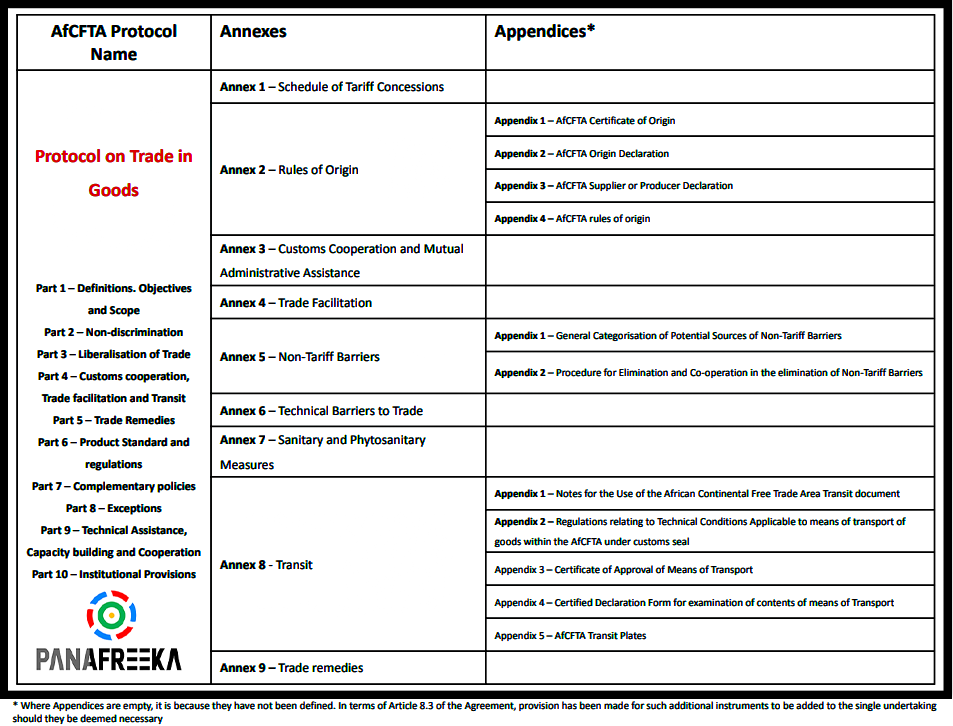
Annex 7 – Sanitary and Phytosanitary measures
In our concluding remarks for the Technical barriers to trade, we pointed out that no amount of Free Trade Concessions is worth the compromise on safety and quality. This statement also applies to Sanitary and Phytosanitary Measures. The Sanitary (human and animal health) and Phytosanitary (Plant health) measures are yet another example of Non-Trade barriers and the objective of this Annex is twofold. First, it sets out the basic rules for safeguarding human, animal or plant life or health in the territory of State Parties and then it enhances cooperation and transparency in the development of these measures to ensure that they do not become unjustifiable barriers to trade.
When a business wants access to a new market (i.e. market of another State Party) under the Agreement, they will apply for a market access request. State Parties are then obliged to assess the risk by taking into account several considerations. These considerations are layered. For example, they take into account scientific evidence if available. They also look into the manufacturing conditions and methods at the manufacturer as well as consider regional conditions of the source of such products. Regional conditions will include assessing the prevalence of specific diseases or pests, relevant ecological and environmental conditions and how these can affect the local (potential export) population.
These considerations also look into local economic factors such as the potential damage in terms of loss of production or sales in the event of the market access request being granted. Local economic factors are not limited to just the economic threat of a new entrant but also what would happen to the economy should a spread of a pest or a disease from such products manifest as such impact may spread beyond the industry concerned.
To summarise, the Sanitary and Phytosanitary measures will aim to strike a balance between creating some barriers in the form of acceptable standards of safety to human, animal and plant health and putting measures in place to ensure that these barriers are indeed reasonable and do not result in unjustifiable barriers to trade.
Article 5 of the (Continental Free Trade) Agreement cites Transparency and disclosure of information as one of the principles of this Agreement. This principle (further echoed in Article 11 of the Annex) is especially important for Sanitary and Phytosanitary Measures as it is essential in ensuring clarity, predictability and trust in order to foster intra-Africa trade.
Appendices – Sanitary and Phytosanitary measures
No Appendices relating to this Annex have been published to date. However, in terms of Article 8.3 of the Agreement, provision has been made for such additional instruments in future.
Annex 8 – Transit
When you buy something from another country, there are a series of logistical activities that takes place between the time your order is placed and the time your order is delivered. One of these key activities has to do with Transit. In International Trade relations, Transit makes it possible for the passage of goods like the ones you bought from the purchased territory (e.g. jurisdiction/State Party and/or Country) to your territory and sometimes, for this to take place, such goods may have to pass through other territories.
Within a Free Trade Zone, the process of Transit can ensure that transit traffic freedom is emphasised such that unnecessary delays and frustrations do not become a technical barrier to trade. Annex 8 provides a series of measures to avoid transit-related technical barriers such as granting traffic freedom when transit traffic from (or bound to/affiliated with) a (Continental Free Trade Area) State Party is moving through the territories of another State Party. Furthermore, the Annex undertakes State Parties not to levy any import or export duties on such transit traffic (although there are exceptions to this blanket rule notably found in Article 8 of this Annex).
Finally, one key point to note about this Annex however is that its provisions only applies to transit goods being carried by roads. It does not apply to other forms of cargo transportation.
Appendices – Transit
Appendix 1 – Notes for the Use of the African Continental Free Trade Area Transit Document.
The AfCFTA Transit Document is a Customs Document for transit declaration that MUST accompany all transit goods. This Appendix provides a list of guidelines on what, how, when and where to prepare the document.
Appendix 2 – Regulations relating to the Technical Conditions Applicable to means of transport of goods within the AfCFTA under customs seal
There are instances when it is necessary to install tamper-evident mechanisms on goods that are in transit and for these reasons customs seals are necessary. Customs seal ensures that no goods can be removed from or introduced into the sealed part of the means of transport without obvious damage to it or without breaking the seals.
The purpose of this Appendix is to provide a series of transit criteria that MUST be met for intra-African Continental Free Trade Area transportation of goods by means of transport under Customs Seal. Customs Seal does not mean that the goods cannot be inspected by Customs authorities, but rather it means that they may not tamper with the sealed goods during the inspection. Furthermore, it is possible for a transit transport consignment to be made up of a hybrid of (custom) sealed and unsealed goods and Customs Authorities will be required to handle both categories of goods differently.
Appendix 3 – Certificate of Approval of means of Transport
The Means of Transport is the vessel that is transporting the goods in transit and in order to ensure compliance, a certificate of approval to travel between State Parties must be assigned to all such vehicles. Appendix 3 provides a structure and layout of the certificate of approval which upon approval constitutes a license and must be framed and displayed in the cab of the means of transport.
Appendix 4 – Certified Declaration Form for examination of contents of means of Transport
A lot can go wrong when transporting goods over a long distance. The purpose of the certified declaration form is to document such incidences. This appendix provides a structured layout of the Certified Declaration Form that must be completed by custom authorities or competent authorities (in the event that there are no customs authorities nearby) in the event of certain incidents such as seals being broken en route, goods being destroyed, damaged, stolen or the means of transport is involved in an accident.
The operator or carrier of the means of transport is required to not only abide by the provisions of national laws (at the jurisdiction where the incident happened) but also to request for a certified report drawn up in the form of the Certified Declaration form in this Appendix.
Appendix 5 – AfCFTA Transit Plates
Fellow PanAfreekans, what if we told you that it is possible to “see” the African Continental Free Trade Area? Well, for those of you who are residing in a State Party, we urge you to be on the lookout for vehicles with the number plate “AfCFTA TRANSIT”, the next time you are driving down the road.
In terms of Article 11 of the Annex, all Means of Transport that are engaged in international Transit Traffic operations under the cover of an AfCFTA Transit Document (i.e. Appendix 1) shall have affixed to their front and rear, a plate bearing the letters “AfCFTA TRANSIT”. Appendix 5 provides a list of guidelines to design and install these plates.
References (Ref.)
- Agreement Establishing the African Continental Free Trade Area – African Union
- Protocol on Trade in Goods
- http://www.itac.org.za/pages/services/trade-remedies
Useful Links (UL)
- Agreement Establishing the African Continental Free Trade Area – African Union
- Protocol on Trade in Goods
- https://www.bdc.ca/en/articles-tools/entrepreneur-toolkit/templates-business-guides/glossary/technical-barriers-to-trade
- http://ow.ly/QhZ130rOhSS