
Scope of the African Continental Free Trade Area – [Part A (5 of 9)] – The
AfCFTA Protocol on Trade in Goods, associated Annexes and Appendices [Annexes 5 – 6 of 9]
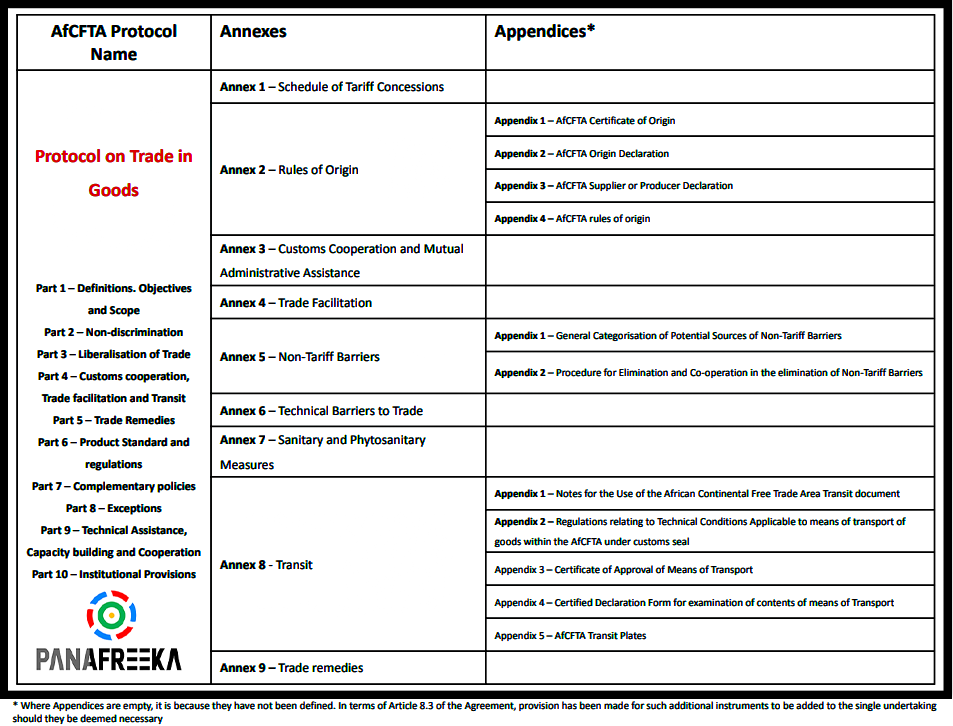
Annex 5 – Non-Tariff Barriers
Article 1 of the (Continental Free Trade) Agreement describes Non-Tariff Barriers (NTB) as barriers that impede trade through mechanisms other than the imposition of tariffs. In other words, tariff concessions are great, but in and of themselves they are not enough to boost intra-African trade. The objective of this Annex is to enable State Parties to work together to identify, categorise, monitor and subsequently eliminate Non-Tariff Barriers.
One of the principles that govern the African Continental Free Trade Area (AfCFTA) is to make use of the Regional Economic Communities (REC) Free Trade Areas as building blocs for the AfCFTA (See Article 4 of the Agreement). In this NTB Annex, we are provided with an example of how RECs and the AfCFTA can collaborate and work together in Article 10.
Article 10 of Annex 5 requires the RECs to establish or strengthen Non-Tariff Barriers monitoring mechanisms. This allows for a multi-faceted approach to addressing Non-Tariff barriers irrespective of whether the trade is between State parties within a REC or between State Parties within the AfCFTA.
Appendices – Non-Tariff Barriers
There are two Appendices for the Non- Tariff Barriers Annex.
Appendix 1 – General Categorisation of Potential Sources of Non-Tariff Barriers
This Appendix provides a list of Categories of Non-Tariff Barriers.
Appendix 2 – Procedure for Elimination and Co-operation in the Elimination of Non-Tariff Barriers
This Appendix provides multi-level procedures that State Parties are expected to follow whenever they require co-operation with their counterparts relating to the elimination and/or resolution of Non-Tariff Barriers.
Annex 6 – Technical Barriers to Trade
One example or category of Non-Tariff Barriers is Technical Barriers to Trade. Technical Barriers to Trade is a barrier to trade that can make it more expensive and difficult to conduct cross border trading. Its technical nature stems from the fact that it could consist of regulations, standards or procedures that could make more difficult the process of exporting goods to another country. For example, the certification of a product in Country A may not be valid in other countries, so if a trader in Country A wants to export that product to other Countries (e.g. Countries B-Z) in the Free Trade Zone, they are faced with the barrier of applying for certification for every Country where the product certification may not be recognised.
The objective of this Annex is to work towards one of the objectives of the (Continental Free Trade) Agreement i.e. boost intra-African trade in goods through the enhanced cooperation (between State Parties) in the areas of technical barriers to trade and sanitary and phytosanitary measures (more on this later) [Article 2 Paragraph 2 of the Agreement].
This Annex has a lot of implications for both domestic and foreign producers. For foreign producers, this Annex will ensure State Parties work together to facilitate trade through cooperation in areas of standards, technical regulation, conformity assessment, accreditation and metrology. It will also work towards identifying and ideally eliminating unnecessary and unjustifiable technical barriers to trade. For domestic producers, this Annex will lower the barriers to entry of foreign producers into the local market (which is not necessarily a disadvantage because whatever setback this causes can be offset by the fact that it will be to the advantage of domestic producers when they are exporting to other markets).
However, this Annex may also cause the domestic producers to challenge local standards, regulations, accreditation and other technical requirements especially if these have been either eliminated or amended for the foreign producers considering that there is in all likelihood a cost-saving in the production line (or in post-production activites like meeting regulatory compliance standards) if some of these technical requirements do not have to be upheld.
It will be fascinating (at least to us here at PanAfreeka) to see how these scenarios play out in the “negotiating rooms” of the various industries but the most important thing for the end consumer is that the quality and safety of the products is not compromised as no amount of free trade concessions is worth that.
Lastly, safety and quality are crucial to boosting intra-African Trade in a more and more globalised world, a Free Trade Zone where a significant size of the population still buys their goods from outside the Free Trade Zone all because they are concerned about the quality of goods that are marketed to consumers does not bode well for the Africa we want.
Appendices – Technical Barriers to Trade
No Appendices relating to this Annex have been published to date. However, in terms of Article 8.3 of the Agreement, provision has been made for such additional instruments in future.
References (Ref.)
- Agreement Establishing the African Continental Free Trade Area – African Union
- Protocol on Trade in Goods
- http://www.itac.org.za/pages/services/trade-remedies
Useful Links (UL)
- Agreement Establishing the African Continental Free Trade Area – African Union
- Protocol on Trade in Goods
- https://www.bdc.ca/en/articles-tools/entrepreneur-toolkit/templates-business-guides/glossary/technical-barriers-to-trade
- http://ow.ly/Uy3y30rMvJS
One thought on “Scope of the African Continental Free Trade Area – [Part A (5 of 9)]”